Showing posts with label policy. Show all posts

Saturday, May 23, 2009

Like Water Dripping on a Stone: Rethinking the Politics of Single-Payer

In the run-up to the universal health-care bill being debated in Congress, one of the more contentious issues on the political left has been the question of single-payer and its’ inclusion or exclusion from the debate. Recently, we’ve seen single-payer advocates getting themselves arrested to draw media attention, a huge amount of back-and-forth within the progressive blogosphere (of which the links here are just a small sampling), and a good deal of fear about the public option getting watered down or eliminated.

I feel somewhat ambivalent in this debate, in part because I agree with the policy of single-payer advocates, but I find myself turned off by their political style. And I think a lot of it has to do with a particular theory of activism and an ahistorical understanding of how social policy happens that I really disagree with.

Especially as we draw closer to the crucial mark-up and voting phases, and ever closer to passage of the Baucus/Kennedy/Dingell/Obama health care legislation, it’s imperative that the progressive movement think very carefully about what we want to accomplish.

Background:

One of the ironies about the debate over the current health care reform versus single-payer is that the basis for the current plan (and indeed, the rough consensus between the Clinton, Edwards, and Obama plans during the 2008 primaries), the “Hacker Plan” – was designed as a compromise measure between gradualists who favored things like the exension of SCHIP in the wake of the Clinton health reform disasters and single-payer advocates.

For those of you not familiar with the Hacker Plan (available here), it basically consists of three key elements:

  1. Employer Pay-Or-Play Mandate – Employers are required either to provide health care for their employees or to pay a payroll tax that goes into a fund for covering the uninsured.
  2. Individual Mandate Plus Sliding Subsidy – Individuals not already covered by their employer would be required to purchase health insurance, either from a public or private insurer; income-based subsidies would ensure that the cost of insurance would be reasonable.
  3. A New Public Insurer – A new, Medicare-like public insurer would be created to act as a competitor/yardstick to private health insurers and to ensure that there is an “insurer of last resort.”
With some alterations (a health care purchasing pool, new emphasis on reforming private insurance, new emphasis on reducing the growth of health care costs, new emphasis on cutting premiums and out-of-pocket costs for the insured, new emphasis on extending SCHIP/Medicare/Medicaid as part of the solution), this is essentially the plan that is being debated.

Single-payer advocates are upset that they are basically being shut out of the debate, and they have a right to be. However, I believe that a certain amount of the anger directed at advocates for “public option” reform is due to the fact that the Hacker Plan has become more or less consensus within a broad segment of the Democratic Party, from as far left as Ted Kennedy/EPI/labor to as far right as Max Baucus and Hillary Clinton, although there remains to be seen how extensive the Blue Dog/Evan Bayh contingent is, and how much they’re actually going to remain outside the consensus on this issue. This has meant that while the single-payer advocates have some base – especially with CTA/NNA (the nurses’ unions) and various health care grassroots groups (HCAN, etc.) – a lot of its natural supporters are now in the “public option” camp, which reduces the constituency for single-payer at the legislator and lobbyist levels. Even if single-payer was to “get a seat at the table,” they’d find that the other chairs – those not reserved for industry – are already taken up by “public option” advocates, and would find themselves on the losing side of a number of internal debates, and we’d probably end up exactly where we are today.

Like I said earlier, I feel very ambivalent about this, because I am ideologically and emotionally sympathetic to single-payer as a policy goal, but I feel really turned off when I see the tactics and strategies being carried out by single-payer advocates as they try to push their ideas back into the debate. For me, this isn’t a theoretical issue, it’s quite personal.

Humphrey Cooper Attewell, my great-grandfather. was elected to the British Parliament in 1945 as the Labor M.P for Harborough. As such, he cast his vote for the establishment of the National Health Service in 1946. The NHS was at the time and remains to this day the one of the most progressive health care systems in the world – a system in which the hospitals belong to the state, where the doctors, nursers, and other medical workers are public employees, and where health care is provided to all for free as a right. In a sense, therefore, the story of single-payer health care is the story of where I come from and who I am.

Yet I find myself oddly turned off when I listen to single-payer advocates, in part because I really disagree with the manner in which they are attempting to push their agenda, both in terms of their tactics and their larger strategy. I don’t find the tactics of single-payer advocates compelling in the slightest; I think direct actions and civil disobedience directed at the chairman of the committee who’s going to decide what health care bill will ever emerge on the floor of the Senate to be totally without merit. Simply put, it does not advance the cause of single-payer at all to piss off Senator Max Baucus, especially since single-payer advocates do not have the resources or the political strength necessary to seriously challenge him either in Montana or in the Senate Democratic Caucus. Strategically, I find the insistence on an all-or-nothing single-payer system to be utterly misguided and contrary to all the lessons that history can teach us about how advances in social policy actually happen.

Take a look at two of the most single-payer nations out there – Canada and the U.K. The Canadian health care system emerged, not in a single all-or-nothing burst, but rather in a gradual process of expansion. In 1944, Tommy Douglas of the CCF (Canada’s socialist part at the time) was elected premier of Saskatchewan on a platform that included free hospital care to all citizens. In 1946, his government passed the Saskatchewan Hospitalization Bill, which provided hospital care (not including physicians’ bills, prescriptions, etc.) to most, but not all residents. It took time to build up enough finances to cover all residents, and to extend coverage to all servcices; full Medicare for the province didn’t come in until 1959. Other provinces began experimenting with universal health coverage; Alberta establishing a pre-paid system that covered 90% of their residents in 1950. It took longer for the system to spread across the country: the first Hospital Insurance and Diagnostic Act in 1957 merely provided 50% of the costs of running health care programs; in 1962, the national government passed legislatuion to include phsyicians costs in the federal susbsidy; in 1966, the national government passed the Medical Care (Medicare) Act, which enabled provinces to establish full Medicare systems based ont he Saskatchewan model; and in 1984, the Canada Health Act established the modern system that Canadians know today.

In the U.K, the move towards single-payer began in 1911, with the introduction of the National Insurance Act by Lloyd George’s Liberal government. This legislation established a national system of health insurance, funded by payroll contributions from workers, employers, and contributions from general taxation – quite different than the current system. However, this system only covered certain trades and occupations of workers paid into the system, and the relatively low government contribution meant that coverage could often be quite expensive. During WWII, the pressures of the mass bombing of civilian populations led to the creation of the Emergency Health Service, which put all medical professionals into government service, created a coordinated national hospital system, and so forth. And finally in 1946, the new Labor government passed the National Health Services Act, establishing the modern National Health Service (NHS) on the basis of three central principles, that services should be free at the point of use, that general taxation should be the source of financing for the system, and that everyone would be eligible for care.

The point of this history lesson is that single-payer has historically developed in a gradual fashion – the Canadian system took forty years to develop into the modern Medicare system, and the British system took more than thirty years. In both cases, it wasn’t a single piece of legislation that made single-payer a reality, but the gradual achievement of partial steps that, like water dripping on a stone, wore down institutional resistance to single-payer.

Which leads us back to the current debate. I think that single-payer advocates should rethink their attachment to immediacy and to all-or-nothing when it comes to achieving their goal of a single-payer system; moreover, I think this will lead towards a re-evaluation of tactics, and the embrace of a strategy that emphasizes allying with public-option advocates to gain entrance into the coalition, so that they can begin pushing for those elements that would make the current proposal a true stepping-stone to single-payer. Here, I’m primarily thinking about ensuring the inclusion of a public option, making that public option as Medicare-like as possible, pushing for more generous income subsidies and more comprehensive minimum stnadards for healthcare plans, and support for states to experiment with single-payer. The passage of any major health care reform would in itself be a major step forward, in that it would break the now forty year gap in major social policy achievements, it would de-stabilize and de-motivate opponents ot health care reform, it would create a political atmosphere more open to single-payer by making universal health care a new “third rail,” and it would create pressures and interest groups to reform and improve and expand the new system.

Furthermore, in policy, passing the bill is only half the battle – implementation is the longer and more crucial phase. Here, I think one way that single-payer advocates can begin to broaden their base while pushing for their objectives is to begin a national campaign to sign people up for the public option, pushing the system closer to single-payer with every person signed up, and concretely solving the crisis of the uninsured. Here, single-payer advocates could usefully work with allies within the labor movement to push all 12.4% of the workforce that’s currently unionized into the public plan, and other social justice groups (union organizing campaigns, civil rights groups, GLBT groups, feminist groups) could plug into the campaign by folding signing people up for public health care as part of their ongoing missions. Moreover, single-payer advocates, by being slightly outside the coalition of public-option advocates, would then be free to begein “raiding” the private insurance market, taking the fight to the private insurance companies by mobilizing their friends, families, neighbors, and co-workers into switching from private to public insurance; you could target major employers with public insurance drives, especially focusing on corporations like GM, Ford, and Chrystler, where the argument for a single-payer (as opposed to employer-based) health care system might resonate.

In my mind, that’s the winning strategy for single-payer.

[+/-] Read More...

Wednesday, May 20, 2009

Re-Post Number 11: "Stimulus Is Not Enough: Job Creation Now!" (Jan 09, 2009)

Note: and that's the last of the re-posts. The context for this post was the political fight over the Obama stimulus package.
---------------------------------------

In the last few months, the U.S economy has seen one of the fastest slides into one of the most terrifying employment declines in American history - we are now losing jobs at the rate of 500,000 a month.

Given this reality, the current stimulus proposal is no longer sufficient. We must move beyond a debate that tries to balance a couple hundred billion in tax cuts with four hundred billion in public works, aid to the states, and traditional stabilizers (UI, food stamps, etc).

In the last few months, the U.S economy has seen one of the fastest slides into one of the most terrifying employment declines in American history - we are now losing jobs at the rate of 500,000 a month. Given this reality, the current stimulus proposal is no longer sufficient. We must move beyond a debate that tries to balance a couple hundred billion in tax cuts with four hundred billion in public works, aid to the states, and traditional stabilizers (UI, food stamps, etc).

What we need are jobs, and jobs now.


Background:

For about two years now, I've been diarying about public employment programs, which I'm studying for a dissertation in U.S Public Policy History. If you're interested in reading more on job creation programs, you can check out any of these diaries:

[edit: see here]

The Current Crisis:

Given the stunning rate of job loss, I believe that traditional stimulus measures will not be adequate to offset the damage being done to the economy. On the jobs front, if we create three million jobs as President-Elect Obama hopes, we may well have only bought ourselves six months of breathing room rather than a lasting improvement. On the consumption side, even if we shovel $1 trillion into the economy, if people are seeing jobs disappear at the rate that they have, their propensity to consume will decrease and their propensity to save will increase as people batten down the hatches against the bad times and save money for when the jobs go. Not to say that it won't have any effect, but it's going to be much much weaker than one would hope.

Given the seriousness of this situation, I think we need to radically re-think the stimulus package. To begin with, the tax cuts need to come out - they're not going to have nearly enough of an effect on people's spending habits if people's psychological posture is determined by an omnipresent fear of layoffs and unemployment. Next, we need to understand that the current commitment to public works is inadequate to the task. While many of the existing public works plans - from greening buildings to building high-speed rail - are quite worthy, the nature of the process of letting out contracts, vetting proposals, and getting the site operational takes too damn long, and will not generate enough jobs fast enough.

What We Need:

As I have argued before (see here), public works are not the policy tool we should be looking to, at least not in the traditional contractor model.

Instead, I believe that the Federal government needs to hire unemployed workers directly and immediately. We should begin by hiring 5.5 million workers right now, to bring the unemployment rate down from 7.2% to 3.6%, and to increase that number at any time to keep the overall unemployment rate at 4% or below if/when additional private sector jobs are lost.

Why? First, we need to dramatically reverse our current downtrend. Creating these jobs would send a dramatic signal to every consumer and producer that mass unemployment is not going to happen, that it is not necessary to cut back in the face of crisis. Second, we need a policy big enough for our economy. Given the sheer scale of the American labor market, in order to send a signal that really resonates, you need to do something at a large enough level that it actually changes the economic reality - cutting unemployment in half is exactly the right kind of signal. Third, every month we wait to create jobs is less income going into the economy and more people falling into poverty - in order to start spending fast enough to get ahead of the deflationary effects of this recession, we need to create jobs faster.

Precedent:

Luckily, we do have precedent for how to do this, in the Civil Works Administration. In the fall of 1933, with unemployment still hovering in the 20% range, Harry Hopkins (the head of FDR's Federal Emergency Relief Administration) went to President Roosevelt with a plan to create 4 million jobs to reduce unemployment and keep people alive during the normal seasonal downturn in unemployment in the winter. To his surprise, Roosevelt agreed, and the CWA was born in October 1933, with a grant of $400 million dollars "borrowed" from FDR's public works program.

In three months, the CWA had created 4.26 million jobs. At a time when the most advanced administrative technology was the carbon copy and the rotary phone, all 4.26 million workers were hired and put to work that quickly. Surely, today we can do better.

The Cost:

Assuming a base salary of $24k/year and a non-salary overhead of 30% (a rather generous assumption, given that New Deal era programs managed to limit non-salary costs to 20%), it should cost roughly $31 billion to put one million people to work for a year. Five and a half million people makes $170.5 billion dollars - well within the current framework of President Elect Obama's $750 billion plus package.

In the end, this is not a question of whether we can find $170 billion to spend; the sheer size of the bailouts and the proposed stimulus package shows that the American government's fiscal powers are much greater than we've been led to believe on social welfare issues. It's more a question of how we spend money, and the ideology contained therein.

Republicans want to give tax breaks because they don't believe in government, and they want to benefit the rich who they believe are best suited to spend the money. Congressional Democrats want to spend the money traditionally, because they're used to spending on traditional areas and constituents (not that their proposed spendings are a bad idea, far from it), and because it's been 70 years since we've done anything like this. Creating millions of jobs directly is a radical departure from standard practice, and Democrats may well be nervous about doing something so drastic.

However, we simply cannot afford to wait.

Please read this, promote this if you can, pass the word on. There is a way out of this crisis, but we just have to remember how we did it last time.

[+/-] Read More...

Sunday, May 17, 2009

Re-Post Number 10: "Going Beyond Obama's Two-And-A-Half: A Case for More Jobs Now" (Dec 06, 2008)


Note: This post refers to the above YouTube Address, and is the last but one of this re-post series.
------------------------
Today, President-Elect Barack Obama went on YouTube to discuss the issue of unemployment, and how to "put people back to work." His proposal was a for public works and government investment in infrastructure and alternative energy, creating two and a half million jobs. At first glance, this is a major transformation in American public policy, since it was the first time that a president has advocated that the government should directly create jobs on a mass scale since 1944, when President Franklin Delano Roosevelt proclaimed that "true individual freedom cannot exist without economic security and independence," and argued that "the right to a useful and remunerative job" should belong to all Americans. His vision was first proposed in law a year later as the Full Employment Bill of 1945, the high water mark of American liberal economic policy never again reached.

To that extent, Obama’s YouTube address constitutes a quiet revolution, a small yet telling sign that change comes to Washington in many way.

But it’s not enough.


(Disclaimer: I'm a PhD student in policy history, writing my dissertation on direct job creation policy, so I'm unreasonably obsessed about this topic.

Studying the job creation proposals that Obama’s campaign and his transition team has put forward (see here), we see a certain amount of caution and division as to how to achieve his goal of 2.5 million new jobs in two years: Obama has proposed $50 billion to the states to prevent cutbacks in spending and stimulate construction, a National Infrastructure Reinvestment Bank to invest $60 billion over 10 years; an Advanced Manufacturing Fund and a Manufacturing Extensive Partnership to push private-sector job creation; $150 billion over 10 years to create a Green Energy Economy; a Green Jobs Corps which appears to be a mix of jobs and jobs-training; and $1 billion over five years in transitional jobs. Some common themes emerge: first, a preference for indirect creation, either through the states or through private industry; second, an emphasis on long-term rather than short term; and third, a general tendency to small-bore approaches. The policy history literature on these approaches suggests that these are not the most effective way to create jobs.

Even if every item on this list passes into law, and creates the 2.5 million jobs that are hoped for, it would still only bring unemployment down from its projected peak of 8.5% to 7.25%, still far above normal levels and far away from FDR’s call for a job for all who wanted it. If we really do want to change national economic policy and get our country moving again, we need to think bigger and bolder.

Luckily, we have a model for how to create jobs immediately. In October 1933, in the depths of the Great Depression, Federal Relief Administrator Harry Hopkins pitched an audacious plan to President Roosevelt: create four million jobs directly by the Federal government, and then put people to work building necessary public goods, and do it all by Christmas. FDR signed off on the idea and the Civil Works Administration was born in November, with a month to go. Through Herculean efforts, Hopkins and his staff hit their goal and then some – by January, 4, 263,644 people reported for work. Though the CWA was a brief prelude to the later Works Progress Administration, its results were staggering. In six months, the workers of the CWA built nearly a half million miles of road; 7,000 bridges and 4,000 schools and 1,000 airports; the murals at Coit Tower in San Francisco and the Zoo at Central Park in New York stand as silent witnesses to their labor.

My advice to President-Elect Obama is that, yes he can do more. In the words of his Chief of Staff-designate Rahm Emanuel, the new administration will need to "throw deep and long" to deal with the crisis of unemployment. To accomplish this task, I recommend the following principles:

Think Big: the American economy and the American labor force is leviathan in scope, so a small-bore strategy, such as $1 billion for transitional jobs would have little macroeconomic impact and would serve only a small fraction of the unemployed. Four and a half million jobs, on the other hand, would immediately reduce unemployment from a hypothetical 8.5% to 6.25%, getting us half-way out of our current slump in one move (even before any Keynesian effect on the private sector). Not only would this have an enormous stimulatory effect on the economy, but it would also embrace almost a third of those in need of a job – a true down-payment on reform.

Focus on the People First, the Works Second: one of the reasons why public works programs are often less effective than their creators hope is that they focus on the works more than the public being helped – the money appropriated goes mostly towards land, equipment, materials, the jobs go to private contractors who are more likely to be employed already, and the impact of the program on unemployment is lessened. Focus first on putting four and a half million people to work, then focus on how you can use the sheer labor power of four and a half million people to accomplish your goals of renewing infrastructure and creating a new green energy economy. The results will flow – nine million hands working together can build as many schools as you like, install as many solar panels as you like, or throw up as many free wireless towers as you like.

Do It Now, Not Over Two Years: the longer we wait for these jobs to create, the harder a time you’re going to have getting the economy going again, even with a big stimulus package. But with four and a half million workers drawing paychecks (I would suggest paying $24,000 a year, so that these newly created jobs can fight not just unemployment, but poverty as well) every month, you would be able to create a steady stream of stimulus to the tune of $9 billion a month, flowing into the economy from the bottom up, exactly in the fashion most likely to cause the most re-spendings, and the greatest economic impact. Moreover, if FDR and Harry Hopkins could, at a time when carbon copy and the rotary phone were the heights in administrative technology, do all this in three months, you might be able to head off unemployment before it gets to 8.5%, and reducing unemployment from 6.5% to 4.25% would drastically cut short our current recession.

Why Does This Matter?

A reasonable person might ask, why quibble over the difference between two and four million? Isn't Obama already doing what you're asking him to do? Why does this matter?

Ultimately, it matters because of scale - the American economy is a leviathan, even if it's sick, and the scale of the jobs crisis is huge when we're losing a half-million jobs a month. In order to reverse the crisis, you need to send a signal to the system that's big enough to make every part of the economy sit up and take notice, that can actually move the macro-level of the economy in a significant way.

However, there's another issue - I want the U.S government, our political parties, and the American electorate to start thinking not just in terms of millions of jobs but in terms of percentage of current unemployment. The ultimate promise of public employment, the thread that runs from the CWA to the Full Employment Bill, is that the unemployment rate can be determined through collective democratic action, that we can establish full employment if we recognize the right of all citizens who want to work to a job. If we can restore that belief, that policy knowledge, then we can not just end this recession, but prevent the next one as it happens.

[+/-] Read More...

Wednesday, May 13, 2009

Re-Post Number 9: "Obama's Choice on Jobs Policy - Job Training or Job Creation?" (Oct 16, 2008)

Note: this repost, one of the last three to go, focuses on the difference between job training and job creation, and why the former is a weak policy option that doesn't begin to address serious structural problems in the American economic system.

------------------------------------------------
This diary is a follow-up from yesterday's diary here on Obama's proposals on jobs policy, in which I discussed how Obama's proposals are a vast improvement on previous Democratic nominees, but show a shot-gun approach that combines a number of different approaches to doing the same thing.

Today, I'm going to be talking about one choice, the choice between providing job-training programs (with the ultimate view being to get the currently unemployed back into the private-sector workforce) and providing direct job creation programs (with the ultimate view being to create new public-sector jobs to make up for the lack of private-sector jobs).


Background:

The debate over job-training and job-creation stretches back to debates within post-WWII liberal policy circles, starting with the fight between Fiscal Keynesians and Social Keynesians in the immediate post-war years. Just to summarize an earlier diary on the difference between the two here:
  • Fiscal Keynesians believed that you could achieve Keynesian goals (such as full employment, economic growth, consumer purchasing power, increasing investment, and the like) through the use of the "fisc and the Fed" - i.e, increasing or decreasing aggregate Federal spending on existing programs and increasing or decreasing interest rates.
  • Social Keynesians believed that such measures were inadequate, that the form of government spending was crucial to its effectiveness, and that the government would especially have to take a more interventionist role in ensuring that a high enough volume investment flowed in productive directions.
I don't want to get bogged down on this, but the parallels to recent economic policy is rather striking. In regards to the form of government spending, Social Keynesians pointed out that spending on poor and working class people would produce a higher multiplier effect than spending on middle class and rich people because poor people have a higher marginal propensity to consume and, because they tended to purchase mass-produced goods in a variety of industries instead of a few luxury goods, would lead to more respendings, as the people they bought goods from went out and bought goods of their own. Ironically, this insight has completely been ignored in the last eight years of tax cutting, especially during the last stimulus package debate over income rebates vs. unemployment insurance and food stamps. In regards to both form and investment, Social Keynesians argued that government spending on public works would be better than just handing out money, because the public works would add to productive infrastructure; moreover, they argued that since the stock market and financial industry tended to focus too much money and effort in beating the market or unproductive financial instruments, that public investment was needed to keep technological innovation, productivity, transportation, etc. all running at peak efficiency. Very different from solving our economic crisis through buying toxic financial instruments.

Job Training:
But to get back on topic, this division between the two camps was instrumental in shaping post-war liberal economic policy. During the 1940's, the defeat of the Full Employment Bill was due as much to the lukewarm feelings of Fiscal Keynesians and those politicians who followed their teachings as it did to conservative opposition.

The next crucial episode was a largely invisible fight within the Kennedy Administration in 1963 between the Fiscal Keynesians of the Council of Economic Advisors, led by Alvin Hansen, and the Social Keynesians of the Labor Department, led by Secretary Willard Wirtz over which direction the proposed War on Poverty would take. In Economics, Bureaucracy, and Race, Judith Russell describes the clash vividly. Alvin Hansen and his group, all of them staunch Great Society liberals, believed that fiscal and Fed policy could produce full employment and that a combination of anti-discrimination, compensatory education, and job-training programs would allow poor African-Americans and rural whites to escape their economic ghettos, reducing poverty without the need for messy, political controversial, expensive, and inefficient government intervention in the labor market. In this view, the poverty and unemployment of poor blacks and whites stemmed from the lack of job skills and education resulting from a "culture of poverty" within the ghetto. Willard Wirtz and his supporters, who came out of a more laborite sort of liberalism, argued that structural racial discrimination and the inherent weaknesses of the private labor market required the government to directly provide jobs and make investments in depressed areas, since the private sector wouldn't yet invest in ghettos or their residents. In their view, poverty and unemployment were caused by structural failures in American capitalism, not individual failings.

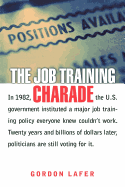
Ultimately, Hansen won. The results of the War on Poverty are instructive: great strides were made, especially in elderly poverty. But the major jobs crisis of the ghettos was not addressed. Compensatory programs in education and job training were helpless in the face of overwhelming economic forces and structures. As Gorden Lafer points out in The Job Training Charade, these programs often provided few actual real skills - what are called "hard skills," like training to become a carpenter, plumber, bricklayer, or electrician (or programmer, hospital tech, solar-panel installer, etc.) - but rather focused on "soft" skills like resume writing, interview training, and "job habits." When the graduates of these programs, provided with few marketable skills, were thrown onto a job market that had virtually no jobs for ghetto residents, they failed to find any work, and were shuttled back into the program to undergo another round of "training," trying to make ends meet on skimpy cost-of-living grants.

Despite this failure, job-training has become the hegemonic jobs policy, especially in the 20 years since the rise of Reagan eliminated the last gasp of direct job creation efforts of the 1970's. Ultimately, the question of jobs became inextricably linked to the politics of trade and welfare: the question of what should be done with former steelworkers or former welfare moms became inextricably linked to the question of whether "free trade is working" or "welfare reform is working," and the knottier political question of what the relationship between the state and the market, and between the state and its citizens should be.

What Does This Mean for Obama?

Throughout debates over NAFTA or welfare reform or economic policy, Democrats since the 1980's have continued the fight over how to deal with the major economic change in post-1970s America: increasing job insecurity, flatlining wages, and the decline in good, union, blue collar jobs that high-school graduates could use to support a family. The solution promoted by New Democrats like Bill Clinton was to provide Transition Assistance (read: extra unemployment insurance for people whose jobs have left for China), and more job training, to prepare us for the job market of the new high-tech future. On the other side, a scattering of progressives, from Congressional liberals to unions to academics, argued instead for what was variously termed "infrastructure investment," "public investment," or public works. There wasn't and hasn't been a whole lot of coherence or political influence behind this counter-argument, and certainly during the Clinton years, talk of public works dropped from the agenda.

For a while, the Clinton approach seemed to work: the good times of the 1990's seemed to suggest a kind of neo-Fiscal Keynesianism, where low interest rates and balanced budgets and deficit reduction would produce economic growth, low unemployment, and public surpluses that could be used to provide for programs to compensate the economic losers, and help them move into the economic mainstream.

However, the past eight years have begun, ever so slowly, to change the dynamic. First, there was Katrina; then, the Minneapolis bridge collapse. At the same time, many major thinkers who had previously been on what could be called the neoliberal side began to shift quite dramatically, driven by concerns about rising inequality and other indicators that their belief in the rising tide lifting all boats had been misplaced: Larry Summers, Bob Rubin, Joe Stiglitz, Jeffrey Sachs, and Paul Krugman (yes, even Krugman) are all former pro-neoliberal thinkers who've seen the light over the last ten years. Especially in the wake of the financial collapse and the nationalization of the banking system, the mood on Capital Hill has swung much more in the direction of government intervention, considered more broadly.

Despite this shift, the status quo is very much uncertain, balancing between the idea that "transition assistance" and job-training is all that is needed to reverse increasing inequality and poverty and unemployment, and the idea that we have to do more.

One hopeful sign that suggests that the choice might come down on the side of jobs programs that have proven to work is the subtle, but remarkable shifts that we have seen since 2004. In 2004, all of the Democratic candidates proposed policies to "grow jobs, make jobs, build jobs, create jobs," and so on - but the ultimate policies came down to throwing money at the economy and making it stick. Such policies that actually directed themselves at workers tended to be of the job-training kind. 2008 saw an important shift, and if there is anything that Senator John Edwards can still be proud of, it's that he put the idea of "1 million public jobs" on the political agenda, and made Obama respond to that.

As we saw last time, Obama's response shows influences from many different approaches, which makes it hard to predict what would happen should he win, and propose a jobs program, what he would choose to do. Partly the confusion comes from the very broad strokes that his campaign has drawn (which is tactically shrewd and properly cautious), it's hard to tell how much money would go into the Green Jobs Corps (and whether it's a job-training program or a jobs program) or what exact form the Jobs and Growth Fund, National Infrastructure Reinvestment Bank, and "invest $150 billion" to create "Create 5 Million New Green Jobs" will take.

Conclusion:

Very simply, I would call upon Obama, congressional Democrats, and the progressive community more broadly, to eschew job-training proposals and similar hands-off approaches. They do not work, never have worked, and stem from a fundamentally wrong-headed view that unemployment stems from shortcomings of the unemployed, and that public policy should focus on making the unemployed better workers, not on economic structure.

Jobs creation, by contrast, has a proven record of success. When FDR and Harry Hopkins announced the creation of the Civil Works Administration in 1933, they created 4.2 million jobs in 3 months. When the WPA was in effect between 1935-1942, the Roosevelt Administration knew that anywhere from 2-3.5 million jobs at least had been created, not even counting jobs created in the private sector.

Starting January 2009, the next president will inherit an economy in steep recession, with an unemployment rate of anywhere from 6.1% (our current rate) to 8% (Obama's estimate) or possibly more. Economic recovery in the private sector is something that the next president and the next Congress should push for. However, private-sector recovery (as we have seen during the Bush Administration) does not necessarily mean that you assume large-scale job growth. Public-sector job creation policy, by contrast, will provide the next administration with a backstop or floor - that no matter what happens on Wall Street, they can count on X number of jobs being created.

In a nutshell: down with job-training, up with job creation!

[+/-] Read More...

Tuesday, May 12, 2009

Industrial Democracy: The True Meaning of EFCA


The back-and-forth over the Employee Free Choice Act is often hard to decipher; like negotiations over health care or climate change, the real work is happening quietly behind the closed doors of committees and Congressional offices while the propaganda wars rage above them. Occasionally, there's a sudden announcement as a senator picks sides, but that's it.

It's a bit like a classic medieval siege - all the visible action is the catapults flinging giant rocks through the air, but beneath the ground, there are teams of miners burrowing under the walls.

But for all the confusion, it's important to take a step back and ask ourselves what the true importance of EFCA really is.

Where We Stand:

At the moment, the picture for EFCA is rather blurred. Most Democrats are on board, virtually every Republican is against, and significant numbers of moderate-to-conservative Democrats are walking sideways (Bayh, Lincoln, even our own Senator Feinstein). Arlen's Specter's switch to the Democratic party and non-switch on EFCA is a good sort of symbol of the ambiguity - neither here nor there.

Ezra Klein points out an interesting piece in the Washington Post:

That approach is being floated in Congress by, among others, Sen. Arlen Specter (D-Pa.), who suggested that an election be held within three weeks of the union filing such a request with the National Labor Relations Board and that union organizers be allowed "equal time under identical circumstances" to make their pitch to employees if management has held "captive audience" speeches making the anti-union case.

Floated "compromises" like this are difficult to suss out. Specter's compromise, that's being backed by Costco, Starbucks, and Whole Foods (and Lanny Davis), basically chops out card check and arbitration, but adds in a shorter, 15-day election campaign, guarantees "equal access" (organizers would have access to the workplace during the workday, on equal terms so that if management holds a captive audience meeting, labor gets one too), and increased unfair labor practices penalties. There's also another proposal being backed by Jay Krupin, called the 70/50/30 plan, that allows for card-check if you bring in 70% in cards, that chops the election campaign to 15 days if you bring in 50% in cards, and that guarantees "equal access" if you bring in 30% of cards.

These compromises leave me feeling rather ambivalent. On the one hand, passing EFCA straight-up would be best, and I still think there's a reasonable shot at getting it if Specter and the sideways Dems are willing to vote for cloture and then against the bill so that it passes with less than 60. On the other, I think these compromises are positive indications - first, because they indicate that the waverers and at least part of the business community doesn't think they can actually defeat the bill without paying a big price, and second, because it's focusing real attention on the unfairness of our labor elections system and forcing opponents to justify captive-audience meetings and barring labor organizers from campaigning on company property.

As Ezra points out, "The corporate community opposes this, too. But having predicated their assault on a principled belief in "workplace democracy," it's extremely hard for them to credibly oppose reforms that would help bring democracy to the workplace...the business community has made a bad decision centering their counterattack around workplace democracy."

These days, I am feeling more confident about the prospects of passing something - and that's what really matters. Especially when we're caught up in the passion of the moment, trying to push this bill through, it's important to remember our history and why laws are really important.

On June 16, 1933, President Franklin Delano Roosevelt signed the National Industrial Recovery Act (NIRA) into law. Among other things, the law established a system of industrial codes by which corporations could set price floors, production agreements, market share agreements, and so on. The sop to labor was Section 7a, which read:
Employees shall have the right to organize and bargain collectively through representatives of their own choosing, and shall be free from the interference, restraint or coercion of employers of labor, or their agents, in the designation of such representatives or in self-organization or in other activities for the purpose of collective bargaining or other mutual aid or protection

This provision was almost entirely ignored by employers, who continued to establish company unions and enforce the open shop, and the law itself would be declared unconstitutional two years later. Yet 7a lead to a huge upsurge in labor organizing, as millions of workers surged into the AFL. Why such a change, even when the law hadn't actually changed?

Because after June 16, 1933, labor organizers could go into any workplace in America and say "the president wants you to join the union," could point to 7a and reframe the entire conversation about joining a union as being the exercise of your rights as an American, and cast the conflict between workers and bosses as a conflict between patriotic citizens upholding the rule of law, and greedy, lawbreaking fat cats. In Fabric of Defeat, Bryant Simon writes about textile mill strikes where workers marched on mills defended with machine-gun nests and private armies, waving the American flag and led by preachers who declared that the union crusade was a fulfillment of Christ's Sermon on the Mount. Symbols matter, and in the United States, the presidency and the law are still important symbols.

Labor historians talk about the impulse behind this phase of the 1930s union upsurge as "industrial democracy." Industrial democracy is a remarkably fluid term that at its most expansive form imagines workers owning the factory and organized through an internal democracy with management elected by the workers; or a system in which workers and unions have a say not just in bargaining for wages and benefits, but also deciding questions of pricing and design and organization and production;or a tripartite collaboration between labor, business, and government. But another form that labor historians talk about is instilling the "rule of law" inside the factory. If we think about it, the workspace is one of the least American places we live in - somewhere where the concepts of free speech or the rights of the individual or equality before the law, things we automatically assume are functioning everywhere we go in America- do not operate.

The idea of industrial democracy in the wake of 1933 was that 7a had extended the rule of law into the factory, that you had the fundamental right to tell your foreman that he was a son-of-a-bitch, the right to be treated with dignity when you needed to use the bathroom or eat lunch or even talk, or the fundamental right to not be fired without a good reason. And it was the belief in those rights that brought so many people under the union banner, even when the rights in question existed only in their minds.

So if we can pass a law, even if it gets us part of the way, if we can get a picture of Barack Obama signing a piece of paper and telling the tv audience that they have a legal right to join a union, that might be all the opening the labor movement needs to begin the hard work of changing this country.

Note bene, though. This does not mean that any compromise is legitimate, or desirable. To me, there are some "bright lines" that have to be honored:
  1. Either Card Check or Fair Elections - in negotiations, it's always a good idea to go in asking 200% of what you want so you end up closer to 100% rather than 50%. Thus, while it's tempting for Democrats who are walking sideways on EFCA to look for a compromise that ditches the "controversial" card check provisions, there has to be some serious returns in exchange. Equal access and 15-days is a bare minimum; negotiators should ask for the abolition of one-on-one meetings without a union rep present, the abolition of the prophecy doctrine, campaign finance for union elections, and anything else necessary for truly fair elections.
  2. Binding Arbitration - according to the Federal Mediation and Conciliation Service, 33-46% of successfully-recognized bargaining units fail to reach a first contract, because employers can easily and painlessly extend bargaining, appeal, stretch things out until workers get frustrated and give up. If you look at the compromises being offered by retailers, arbitration is the one thing they don't mention, because it's hard to defend dragging your feet, but it's also a key fulcrum of labor relations. I think labor should fight hardest here, and demand some form of binding arbitration for first contracts as the "drop dead" line on EFCA.
  3. Labor Penalties - sadly, this is one area where employers don't care and cheerfully throw in expanded unfair labor practices penalties, because even tripling the costs makes the accounting come out in favor of firing and paying the penalty down the road. Labor should not "weight" compromises here very heavily; even if senators start larding up penalties, it's unlikely to make a difference unless punitive damages come on the table.
So there you have it.

[+/-] Read More...

Tuesday, May 5, 2009

Re-Post Number 8: "Jobs How? An Introduction to Obama's Jobs Policy" (Oct 15, 2008)

Note: This is one of the last re-posts, dealing now with the nature of jobs policy in the new Obama administration.

--------------------------------------
A little bit of background: this essay stems from several years of research on job-creation policy colliding with the 2008 election. As you may have noticed, Obama's anti-poverty platform and his economic recovery plan both have a focus on jobs; it's a major part of the Democratic stump speech (not just in Obama's speeches, but also in the speeches of his surrogates); it's a winning issue at a time when unemployment hovers at 6.1% and may rise as high as 8% in the coming recession.

This essay is a pitch, both to the Obama campaign, to progressives, and to Congressional Democrats that the time is ripe for a new direction for jobs policy, from an approach that emphasizes job training and private sector job creation, to an approach that emphasizes on-the-job training and public sector job creation in light construction, "public works," and social services.

Background:

The current Obama platform includes the following jobs-related policies:
  • Provide $50 billion to Jumpstart the Economy and Prevent 1 Million Americans from Losing Their Jobs: This relief would include a $25 billion State Growth Fund to prevent state and local cuts in health, education, housing, and heating assistance or counterproductive increases in property taxes, tolls or fees. The Obama-Biden relief plan will also include $25 billion in a Jobs and Growth Fund to prevent cutbacks in road and bridge maintenance and fund school re­pair - all to save more than 1 million jobs in danger of being cut.
  • Reward Companies that Support American Workers: Barack Obama introduced the Patriot Employer Act of 2007 with Senators Richard Durbin (D-IL) and Sherrod Brown (D-OH) to reward companies that create good jobs with good benefits for American workers. The legislation would provide a tax credit to companies that maintain or increase the number of full-time workers in America relative to those outside the US; maintain their corporate headquarters in America if it has ever been in America; pay decent wages; prepare workers for retirement; provide health insurance; and support employees who serve in the military.
  • Create a National Infrastructure Reinvestment Bank: Barack Obama and Joe Biden will address the infrastructure challenge by creating a National Infrastructure Reinvestment Bank to expand and enhance, not supplant, existing federal transportation investments. This independent entity will be directed to invest in our nation’s most challenging transportation infrastructure needs. The Bank will receive an infusion of federal money, $60 billion over 10 years, to provide financing to transportation infrastructure projects across the nation. These projects will create up to two million new direct and indirect jobs and stimulate approximately $35 billion per year in new economic activity.
  • Invest in our Next Generation Innovators and Job Creators: Obama and Biden will create an Advanced Manufacturing Fund to identify and invest in the most compelling advanced manufacturing strategies. The Fund will have a peer-review selection and award process based on the Michigan 21st Century Jobs Fund, a state-level initiative that has awarded over $125 million to Michigan businesses with the most innovative proposals to create new products and new jobs in the state.
  • Double Funding for the Manufacturing Extension Partnership: The Manufacturing Extension Partnership (MEP) works with manufacturers across the country to improve efficiency, implement new technology and strengthen company growth. This highly-successful program has engaged in more than 350,000 projects across the country and in 2006 alone, helped create and protect over 50,000 jobs. But despite this success, funding for MEP has been slashed by the Bush administration. Barack Obama and Joe Biden will double funding for the MEP so its training centers can continue to bolster the competitiveness of U.S. manufacturers.
  • Invest In A Clean Energy Economy And Create 5 Million New Green Jobs: Obama and Biden will invest $150 billion over 10 years to advance the next generation of biofuels and fuel infrastructure, accelerate the commercialization of plug-in hybrids, promote development of commercial scale renewable energy, invest in low emissions coal plants, and begin transition to a new digital electricity grid. The plan will also invest in America's highly-skilled manufacturing workforce and manufacturing centers to ensure that American workers have the skills and tools they need to pioneer the first wave of green technologies that will be in high demand throughout the world.
  • Help Americans Grab a Hold of and Climb the Job Ladder: Obama and Biden will invest $1 billion over five years in transitional jobs and career pathway programs that implement proven methods of helping low-income Americans succeed in the workforce.
  • Create a Green Jobs Corps: Obama and Biden will create a program to directly engage disadvantaged youth in energy efficiency opportunities to strengthen their communities, while also providing them with practical skills in this important high-growth career field.
His Monday speech, "Rescue Plan for the Middle Class" also included several jobs-related policies:
  • A New American Jobs Tax Credit: Obama will provide a new temporary tax credit to companies that add jobs here in the United States. During 2009 and 2010, existing businesses will receive a $3,000 refundable tax credit for each additional full-time employee hired. For example, if a company that currently has 10 U.S. employees increases its domestic full time employment to 20 employees, this company would get a $30,000 tax credit—enough to offset the entire added payroll tax costs to the company for the first $50,000 of income for the new employees. The tax credit will benefit all companies creating net new jobs, even those struggling to make a profit.
  • Save one million jobs through immediate investments to rebuild America’s roads and bridges and repair our schools: The Obama emergency plan would make $25 billion immediately available in a Jobs and Growth Fund to help ensure that in-progress and fast-tracked infrastructure projects are not sidelined, and to ensure that schools can meet their energy costs and undertake key repairs starting this fall. This increased investment is necessary to stem growing budget pressures on infrastructure projects. In addition, in an environment where we may face elevated unemployment levels well into 2009, making an aggressive investment in urgent, high-priority infrastructure will serve as a triple win: generating capital deployment and job creation to boost our economy in the near-term, enhancing U.S. competitiveness in the longer term, and improving the environment by adopting energy efficient school and infrastructure repairs. In total, Obama’s $25 billion investment will result in 1 million jobs created or saved, while helping to turn our economy around.
-----------------------------------------------------

Now, all of these proposals are great in and of themselves, and they represent a huge leap from 2000 and 2004 in terms of a Democratic commitment to providing and creating jobs - moreover, in comparison to New Democrat priorities in the Clinton years, they really show the revolution in Democratic economic policy since the advent of the Bush years. In that regard, I have nothing but praise for Obama.

However, one thing that's clear is that there is a real tension between different strategies: the State Growth Fund, Jobs and Growth Fund, National Infrastructure Reinvestment Bank, and similar projects constitute a "public works" approach - creating jobs through public investments, primarily in infrastructure. This is a tried and true strategy of the Democratic Party in dealing with economic downturns. The Patriot Employer Act, New American Jobs Tax Credit, Manufacturing Extension Partnership, and Advanced Manufacturing Fund represent a similar, more private-sector approach that could be called a "labor demand" source - creating private jobs with public incentives. This is also a long-running approach to job creation, dating back to the Area Redevelopment Acts of the 1950s and 1960s. Finally, the "career pathway programs" and "Green Jobs Corps" represent more of a job-training approach - you'll note that the actual transitional jobs in question are rather hard to pin down in terms of numbers, but $1 billion over five years is not an encouraging signs. In any case, it's quite different from John Edwards' proposal for one million public jobs in the primaries.

Now each of these strategies have advantages and disadvantages. I'm very much a biased partisan on this question; from my research, I think that direct job creation is best, followed by public works, followed by labor demand, and job training is the worst form of jobs policy. For more on direct job creation, I highly suggest Helen Ginsburg's Full Employment and Public Policy or Phillip Harvey's Securing the Right to Employment. For more on public works, I'd suggest Robert Leighninger's Long-Term Public Investment or Jason Scott Smith's Building New Deal Liberalism. For more on "labor demand" policy, I'd recommend Timothy Barthik's weighty study Jobs For the Poor. For more on jobs training policy, I'd recommend Gordon Lafer's The Job Training Charade.

----------------------------------------------------

So why does all of this technical stuff matter?

Firstly, size, scope, and scale matter. The American economy, labor market, and working class are huge institutions and groups, and if you want to have a real impact on the jobs picture, you need to do something big. The Works Progress Administration worked because it provided jobs to a third of the unemployed; CETA didn't work because it provided jobs to only 725,000 people at a time when there were more than six million people unemployed (or 12% of the unemployed). Hence, spreading yourself across nearly a dozen programs could well mean that you create quite a few jobs here and there, but not the same kind of numbers you could create by maximizing your spending in the most effective area. It also means that the ultimate size of the program matters - a billion here or there over five years won't cut it, but if you were to take the $700 billion bailout and create $20k/year jobs with it, you'd employ every unemployed person twice over. Roughly speaking, it costs $30 billion/year to create 1 million jobs at $20k/year, which reduces the unemployment rate by half a percentage point.

Secondly, policy design has political consequences. Public jobs tend to produce public acceptance of and advocacy for the idea that the government can and should provide jobs for the jobless, and that the government can and should intervene in the economy to promote social ends. It's for that reason why jobs were at the center of the New Deal, and why one of Reagan's first social spending cuts were the 725,000 jobs of CETA. Thus, a choice between tax cuts and public works says a lot about our beliefs about what causes unemployment and what creates employment, the proper relationship between the public and private sectors, and the proper relationship between the people and their government. Hence, a more progressive policy will, over time, produce a more progressive public - political scientists of the American Political Development school refer to this as policy feedback (although I'd urge taking a pinch or two of salt with this idea).

Thirdly, not all policies are equal. For reasons that I will discuss in my next diary, job-training programs don't work very well; tax cuts are somewhat better but still uneven; public works are better still, but are less efficient in terms of creating lots of jobs quickly; direct job creation or "public employment" is best; the Civil Works Administration famously created 4.2 million jobs in just three months. Because of the political stakes, the consequences of programs will matter: if we invest in jobs policy, and it works, you shift the boundaries of acceptable economic policy in a big way, with the New Deal and its coalitions as a key example. If you do it, and it doesn't work, you establish a conservative conventional wisdom that's very hard to work against - witness the long-term influence of the Reagan Revolution over the last thirty years.

[+/-] Read More...

Saturday, May 2, 2009

Re-Post Number 7: "The Road Not Taken: A People's Bailout" (Oct 03, 2008)

Note: This post begins to shift towards the similarities between historical jobs policy and current events, as the Re-Posting series reaches its second half.
----------------------------------------------------------
The sheer size of the $700 billion bailout proposed by Secretary Paulson staggers the imagination of the American media. Groping for analogies, commentators from all points on the political spectrum, have turned to the past for analogies, dubbing the current proposal the biggest government intervention in the economy "since the Great Depression." But is that really the case?

At first glance, the analogy fails: FDR’s New Deal insured depositors, not bank debts; the Home Owners Lending Corporation provided relief to home-owners in default, not to holders of third-party securities; the government showered Wall Street not with liquidity, but with new regulations. The vision of an activist federal government rescuing beleaguered financial institutions rings false on the most important point – the government sought to rescue people, not firms, and looked beyond immediate crisis to underlying root causes.

As strange as it may seem in an era where conventional wisdom in Washington D.C demands billions for the banks, and not a penny for the people, the leading thinkers of the New Deal understood the Great Depression as caused by a weakness at the foundations of the American economy, and not up in the clouds of financial wizardry. They saw real cause of economic collapse was that the rich had grabbed so much of the nation’s wealth that workers couldn’t afford to buy the goods our economy created.

What’s so strange about the current crisis is that we’ve fallen so far back in our understanding of the economy that we lag behind the New Dealers. Talking heads on CNBC may rattle on about liquidity, counter-party debt agreements, and sub-prime crises, but is the underlying problem so hard to understand? The household incomes of ordinary Americans have stagnated and declined for a decade, and consumers trying to maintain living standards have made up the difference by borrowing heavily on the value of their homes. In those circumstances, who in their right minds would think that home-owners could make huge balloon payments on their sub-prime mortgages, if the real estate boom that increased housing values and allowed for easy re-financing went away? As it turned out, virtually all of corporate America, from Lehman Brothers and Freddie Mac/Fannie Mae to Merrill Lynch, were not in their right minds. And now America is shocked, shocked to find out that the wizards of Wall Street didn’t see the crash coming.

Our current financial crisis wouldn’t have shocked the New Dealers who experienced first-hand the folly of gambling with "other people’s money." For as the legendary economist John Maynard Keynes wrote in 1936, "our usual practice" as investors is "to take the existing situation and project into the future," even when our capacity to predict the future is weak. In a situation of such uncertainty, we cling to the unrealistic belief that tomorrow will always look like today – the collective mind of Wall Street assumed that the good times of the housing bubble would never end, and now assumes that the crisis of liquidity will never pass. Keynes concluded that the government would have to step in, and the New Deal took up the challenge.

But as it turned out, the big bailout that the New Deal engineered was the total opposite of the current proposals of the Bush Administration. In January of 1935, FDR introduced a proposal for $4.8 billion dollars to create three-and-a-half million jobs for the unemployed.

In the midst of the Great Depression, this was a staggering sum – two-and-a-half times the size of the entire Federal budget (equivalent to $6.75 trillion dollars today), the largest in American history at the time. Unlike today, the New Deal bailout went straight to the root cause of the problem – too few workers with not enough money in their pockets – and flowed upwards from the foundations, circulating throughout the economy as wages were spent and re-spent.

The results were dramatic: by 1937, unemployment had fallen from its high of 25% to 14% - a 50% decline! – and GDP had recovered to pre-crash levels. The New Deal bailout worked.

Look at the present day: unemployment has risen to 6.1%, working class family incomes have fallen by more than $2,000 since 2001, and 37.3 million people live in poverty. If these millions of Americans can’t pay their mortgages, the markets can’t recover. Yet the only victim of economic decline that the Bush Administration thinks worthy of support are finance corporations; people in danger of losing their homes are supposed to save themselves. Yet for the $700 billion demanded by Paulson and Bernacke, we could put every single unemployed person in America to work...twice over.

A people’s bailout: a bargain at half the price.

[+/-] Read More...

Saturday, April 18, 2009

Re-Post Number 6: "Public Employment and Economic Planning: History, Theory, Implications" (September 19, 2007)

Note:
You'll note some similarities between this diary and the more recent diary on economic planning and the Apollo Alliance. Luckily, the older diary goes into what future economic planning should look like, providing enough new material to be of interest.
-------------------------------------------------------

History

Economic planning is probably the most obfuscated public policy in American history, bar none. The cries of socialized medicine, the Harry and Louise ads, the current struggles over SCHIP - all of these pale in comparison to the sound and fury raised over economic planning. Conservative Republicans and Democrats called it creeping socialism, Hayek called it creeping fascism, and the public imagination reeled before an onslaught of images of totalitarian control.

The reality was much less terrifying. The NRPB, the National Resources Planning Board, was probably the most influential of the New Deal planning institutions. Ostensibly an institution for rationalizing use of things like coal, oil, timber, etc., the NRPB instead became a place for people to re-think economic planning as an exercise in democracy, as a way of directing the guiding the economy towards goals that enhanced the quality of life for all citizens, as a way of putting the people in charge of their economic life.

Throughout the 1940's, the NRPB published a series of reports, laying out the blueprint for a new kind of American society that would come after the war, a society based on the principles of the Four Freedoms and the Second Bill of Rights proposed by President Roosevelt.

Now how does all of this tie in with public employment? In their reports, the staffers of the NRPB looked to programs like the Works Progress Administration as an example of how the government could provide services en masse to Americans in need. More importantly, the NRPB's reports, especially the 1942 Report titled "Security, Work, and Relief Policies," envisioned the provision of jobs by the Federal government as a permanent policy designed to push the country towards full employment, in conjunction with Keynesian economic policies.

The importance of this shift in economic planning, from the crude efforts to secure price and wage cooperation under the National Recovery Administration to a more sophisticated understanding of the possibilities of public action, was that it expanded the policy imagination of New Deal Democrats far beyond the narrow scope we see today. Moreover, New Deal Democrats had reason to believe that such actions were possible. The WPA had shown that the Federal government could fund and administer mass employment projects and that such projects had a substantial impact on the unemployment rare. The Office of Price Administration, a war-time agency that was given the power to regulate prices and wages, succeeded in holding inflation below 1% in a period of full employment.

Because of these advances, the NRPB believed that the national government could provide the trifecta of broad prosperity: low unemployment, low inflation, high economic growth. In essence, everything that the so-called "golden age" of the 1950-1960's was supposed to have achieved. However, there were two key differences between the golden age as envisioned by the economic planners and the golden age that transpired: first, public employment, price and wage controls, and more expansive social insurance programs would have ensured that prosperity would have flowed from public actions, such that the political will of the people, not the largess of corporate America, would have promoted economic growth. Second, it would have meant that the benefits of post-war growth would have been much more broadly distributed, both to the poor, and to minorities.

The end result, however, was that of political defeat - the de-funding of the NRPB, the watering-down of the Full Employment Act (as discussed in my previous diary), and the demonizing of both public employment and economic planning.

Theory

So what should this tell us about economic planning and public employment?

First, it should remind us that the belief that the government's actions do not influence the economy is historically inaccurate - public action can and has dramatically shaped the economy, altering employment levels and inflation rates for periods of several years at a time. Thus, our understanding of what is and is not possible in terms of economic policy should be expanded beyond the boundaries of the orthodox.

Second, it should make us think about the purposes behind economic policy. It is often a habit of Democrats to focus on particular economic indicators - economic growth, numbers of jobs created, and so forth - instead of picturing a vision of the kind of economy and society that we seek to achieve and then moving towards it.

Third, we must realize that victory begets victories and defeat, defeats - we cannot allow any push we make in the future to be stymied by Republican obstructionism. Just as the defeat of health care in 1994 robbed the Democrats of a major policy victory that would rally the base AND working class voters, so too will defeats on public employment, or any other initiative. More on this topic in my next diary.

In terms of economic planning, we need to shift our theoretical perspective to the global and the long-term. The United States stands at an uncertain point - we are still the world's largest economy, but long term trends in terms of debts, deficits, and balance of trade shows how vulnerable our position is. The American people stand at an even more perilous position - the poor, the working class, and the middle class are all facing stagnating and/or declining fortunes in terms of income, wealth, homeownership, health coverage, and no doubt higher education will be soon to follow.

What then should economic planning aim at?

1. Restore Income to Restore Savings/Balance of Trade/Rough Equality

The American economy has been shored up in recent years by the endless cycle of consumer debt that masks the decline in real incomes. Boosting the purchasing power of the ordinary American would help to restore our internal market- an essential goal, given the variability of the globalized economy. Moreover, it would put our consumer base on a much stronger basis regarding income v. debt, allowing savings, assets accumulation, and investment to increase, and redirecting more income towards the broader economy and away from finance payments, which fuel an over-saturated financial sector.

2. Use Public Employment to Shield Against Globalization

If the reality of living in a globalized economy is that industries shift rapidly across borders, then it becomes essential for the U.S and other developed economies that are likely to lose industries to less developed region to increase, not decrease their social spending. Increasing public employment can keep unemployment rates low, preventing economic decay in areas that are losing jobs, maintaining consumption levels through fueling wages. Moreover, public employment provides a shield against the destabilizing effects of globalization, a safe haven against sudden ups and downs in world markets, by counter-cyclical actions.

3. Use Public Investment to Guide the Economy Forward

Public investment can act in a complementary fashion, to create new industries that take the place of old industries, to improve the national infrastructure upon which industries depend - not just roads, bridges, and levees, but also schools, wireless internet, and research and development into new technologies. This both creates new goods and services, adding to economic growth, but also provides jobs that are designed to be more "grounded" in the American economy than consumer-goods production.

4. Set A Comprehensive Target for Economic Policy

Although we don't admit it, and we don't approach it in as much of a conscious fashion as we need to, there are certain targets that government policy does aim at - inflation at less than 2% a year, economic growth of at least 3% a year have been fairly standard aims. However, they are not targets that particularly benefit ordinary Americans - they don't include wage growth, they don't include unemployment, and they don't include the distribution of wealth in American society.

So when we engage in economic planning, it should be to hit targets that represent the whole of the American economy and the whole of the American people as well.

Implications

I'm sure that many of you are familiar with the Apollo Initiative, a joint project of labor unions and environmental groups to achieve energy independence on a basis of green technology and green jobs.
http://www.apolloalliance.org/...

Now, on it's own, the Apollo Initiative is an impressive policy innovation, envisioning a 10-year, $300 billion push towards alternative energy that envisions a whole host of coordinated policies, subsidies, and tax reforms towards a single end. It's certainly much more innovative than anything we've seen in the last few years.

However, as a model for future policy, it suggests an intriguing possibility for American policy and economic planning. Here we have a model of coordinating economic and social objectives that aims to "do good and do well" at the same time, a way of economic planning without falling into the public relations traps.

Imagine, if you will, a host of Initiatives, all designed to boost economic performance, develop new industries, create jobs, improve the national infrastructure, and benefit the commonweal of the country:

  • Athena Initiative - centered around education (building new schools, recruiting teachers by providing salary bonuses, developing new educational technologies, expanding access to higher education through expanding campuses of both public and private universities - think about it, Harvard rejects all but 7% of applicants, turning away thousands and thousands of superlative students - why not expand the undergraduate body beyond just 6-odd thousand?)
  • Mercury Initiative - centered around telecommunications and information technology (providing free broadband internet, universally compatible cellular phone networks, expanding opportunities for startups in the music and movie business, and so forth).
  • Asclepius Initiative - centered around health care industry (leveraging our current public investments in medicine such as the VA, NIH, etc. into creative new publically-owned generic drugs, providing incentives for healthier work environments, improving our public health systems, using health research to uncover "best methods" of health care, so that more money is put towards care instead of overcare, and so forth).

In this way, the federal government would essentially become the national venture capitalist, using its ability to sustain investments across decades before technologies prove themselves.


[+/-] Read More...

Friday, April 17, 2009

Policy Round-Up: the Apollo Initiative as Democratic Planning

Policy wonks and other people who follow public policy issues are probably familiar with the Apollo Alliance, a blue-green alliance of environmentalists and labor unions that's become a stock part of the Democratic Party's platform on environmental and economic policy. Back in 2004, Kerry signed onto it; Obama basically did the same.

For those of you who aren't familiar with it, the basic idea is to fuse environmental policy - alternative energy, "green tech," energy-efficient building, mass transit - with labor and economic policy - creating new jobs that are well-paid, have good benefits, and are union-friendly, as a way to create new domestic industry and manufacturing. The Apollo Initiative, which they were promoting back in 2004, envisioned $30 billion a year for ten years as a public investment into " promoting new technology, improving manufacturing processes, and expanding markets [of "green tech"]...improving the performance of our existing energy system... construction of high performance, energy efficient buildings...[new sources of] renewable energy...new transit system starts, maintenance of the nation’s passenger train system, development of regional high speed rail networks, and improvements in the nation’s roads and highways." Their current Apollo Program calls for a $50 billion a year for ten year investment in energy-efficient buildings, renewable fuels, a new power grid, increasing efficiency of existing power plants, building mass transit, building fuel-efficient cars...the list goes on and on.

In and of itself, it looks like nothing special - basic, Democratic Party boilerplate, the kind of buzzword-driven wonkery that gets tossed around in primaries and never amounts to nothing. I'm going to argue that it's actually a way to recover a missing part of progressive politics and policy that was lost to us during the Cold War.

Ever since the Progressive Era (1880s-1910s), one of the major political and policy divides has been between the advocates of economic planning and the advocates of the free market. To our modern ears, this sounds a little bit ridiculous - planning recalls the Soviet Five Year Plans, the forced industrializations, lousy steel being made to fit Communist Party quotas that couldn't be used, the whole panoply of anti-communist imagery that people who were born after the start of the Cold War have in our heads. But once, there were great thinkers like Thorstein Veblen, Henry Carter Adams, Richard Ely, and John Bates Clark debated whether the free market was an inevitable facet of economic life, or whether rational planning could replace it.

Enter the New Deal. With the free market in total collapse, economic planning entered into the mainstream of American politics and public policy, and the government for the first time in a non-war situation attempted to direct the course o economic activity. Roughly speaking, three kinds of economic planning were attempted during the New Deal:

Tennessee Valley Authority - founded on May 18th, 1933, the Tennessee Valley Authority (TVA) was an experiment in regional democratic planning. Supported by activist-bureaucrats like David Lilienthal, and Arthur Morgan, the idea behind the TVA was to attack the economic problems of the Tennessee Valley from multiple directions - producing fertilizers and promoting modern farming techniques to raise production, hiring the unemployed to do conservation work, generating electricity and irrigation through the construction of hydro-electric dams, flood-control, reforestation, the development of industry (especially through the provision of cheap hydro-electic power), and so on. The TVA also recognized labor unions, and less successfully sought to find jobs for unemployed African-Americans and women.

However, the idea behind the TVA went far beyond that. In the vision of Arthur Morgan, the key element of the TVA were local democratic planning boards, in which farmers, aided by experts from the TVA, would decide the future of their areas and work to develop their way out of poverty. In the vision of David Lilienthal, the key element of the TVA was the creation of public power utilities which could restore competition, lower the price of electricity and water, and extend services to the underserved - with the ultimate aim being to challenge the monopolistic private utilities on behalf of consumers. While the two bitterly fought, the ultimate vision, of a public intervention into the economy, the creation of public economic power used on behalf of the poor, of attacking every aspect of regional poverty and underdevelopment was a powerful one.

And in a nation supposedly devoted to the free market, the TVA exists to this day as a massive publically-owned industry, a living legacy of economic planning, and one that is politically beloved by Americans of all stripes of political opinion.

National Recovery Administration - founded on June 16th, 1933, the National Recovery Administration (NRA) was an experiment in tripartite economic planning. Promoted by expert-administrators like Don Richberg, Rexford Tugwell, and Raymond Moley, the basic concept of the NRA was that American industry could recover through an increase in prices, production, employment, and wages if government, business, labor worked together. The normal anti-trust laws would be suspended, and Codes would be set up for each industry, establishing codes of "fair competition," setting prices, wages, and hours, abolishing child labor and recognizing labor unions. The idea would be that by reducing competitive pressure and restoring profitability, production and employment would increase and the economy would recover.

The experiment has widely been seen as an utter disaster - codes were widely ignored, especially in regards to minimum wages, maximum hours, and the recognition of unions, red tape and arbitary regulation were blamed for strangling recovery and extneding the Great Depression. It was declared unconstitutional in 1935, and even many New Dealers saw the program's terminationa as a relief from an embarrasment. Economists especially hate the NRA and point to it as the prime example of why interfering with the free market never, ever works.

Myself, I'm a little bit more skeptical. After all, unemployment dropped from 22.9% in 1932 to 14.4% in 1935 (personally, I think that the New Deal's job programs had more to do with this). Prices went from dropping about 10% the year before, to increasing by an average of 3% in 1934 and 1935. Industrial production, which dropped by 25% in the first six months of the NRA, was up by 22% from its May 1933 levels when the NRA was terminated in 1935. If the NRA was so economically damaging, it didn't seem to prevent a recovery from taking place; perhaps the worst that could be said against it is that it was ineffective but benign.

While I wouldn't bet the farm on it, I think the case against the NRA might be worth re-opening.

National Resources Planning Board - the NRPB was founded in 1933, as a modest agency within the Interior Department, with a mandate to plan public works projects so that the Public Works Administration and the Works Progress Administration could have a "shelf" of "shovel-ready projects" to build in the future. In 1939, however, this little policy shop was transferred into the Executive Office of the President, and was given an expanded brief as the central agency for national economic planning. Under the direction of FDR's uncle, Frederick Delano, and the research expertise of Eveline Burns (a Columbia University economist who had consulted for the Committee on Economic Security that established the system we know today as Social Security, and had worked closely with the WPA), the NRPB was tasked with envisioning the future direction of America, in every aspect of life.

By 1939, the New Deal had begun to adopt the theories of Keynesian economics, and many of the economic planners in the NRPB and other agencies thought that they now had the tools to ensure permanent prosperity and full employment, through government activism in the economy. The NRPB's main contribution to this body of thought were a series of reports laying out plans for economic development, government organization, the use of natural resources, and so on. The most important of these reports was Work, Security, and Relief Policies. In this report, the NRPB outlined a vision for a "cradle to grave" welfare state that would cover all Americans who were unable to work, and the "right to a job" for all Americans who wanted to work. In this manner, the government would ensure full employment, and the full production and rapid economic growth that would follow - and the expanded revenues would pay the cost of the welfare state. It was a total economic vision of a new economic order defined by universal rights and characterized by economic security - a world in which no American would ever have to fear poverty.

In the 1940s, the principles of the NRPB's report were introduced into Congress as the Wagner-Murray-Dingell Bill (combining the nationalization of unemployment insurance and disability insurance and the expansion of Social Security with a universal health insurance system), and the Full Employment Act (mandating full employment through Keynesian planning and a public employment program as employer of last resort). It was probably the most left-leaning moment in American history. And the result was total defeat - the Wagner-Murray-Dingell bill went down to defeat every year between 1945 and the present day (John Dingell introduced the bill every year between 1945 and his retirement, his son John Dingell Jr. has continued this tradition); the Full Employment Act was eviscerated in committee and was passed in a toothless, watered-down version; and the NRPB itself was disassembled by a hostile Congress. Once the Cold War had set in, anything that smacked of state planning was demonized as Communistic, socialistic, and red.

Ok, so what's the relation between the Apollo Alliance and the New Deal's economic planning? Because when I look at the Apollo Alliance, I see something that looks like a cross between the NRPB (national forward planning) and the TVA (focused public investment in particular industrial developments). What animates the Apollo Alliance is a vision of a new kind of economy, one that has lower emissions, uses less carbon, is more energy-efficient and self-sufficient with alternative fuels, that has more of a manufacturing base, and develops towards high-density urban development along mass-transit corridors instead of massive sprawl.

What excites me about them is that what we have here are the first glimmerings of an idea, one not seen in seventy years, that the economic future of this country should ultimately be in the hands of a democratically-elected government, and not the whims of the casino we call the free market. Ultimately, if the Apollo Alliance is about anything, it's the idea that through a direct public investment, we can shift ourself from one economic model to another. While this might sound inconsequential to some, I would argue that the lifework of dozens, if not hundred and thousands of activists throughout the twentieth century, so long denied by the forces of fear and anti-communism, testify otherwise.

If we think of the economy and economic forces as similar to the great oceans and the natural laws that govern the winds and the tides, the hope of democratic planning is that we can build a ship and learn to tack into the wind, to guide ourselves with compass and sextant and marine chronometer, and that human reason, rather than the blind workings of fate, shall determine the course of our lives.

[+/-] Read More...